Liu Bei: The Humanist Warlord – Lessons in Resilience and Connection
John: Welcome back to our series on historical figures who teach us how to live better, not just how to conquer. Today, we are looking at a man who is often overshadowed by the brilliant strategists and mighty warriors of his time, yet who arguably possessed the greatest strength of all: the power of human connection. We are discussing Liu Bei (161–223 AD), the founder of the Shu Han state during China’s Three Kingdoms period.
Lila: I’m really looking forward to this one, John. In modern discussions, especially in Japan, I often see him described with very business-like terms. People talk about his origins in 幽州涿郡涿県 ( 現在の河北省涿州市 )—that’s Zhuo County in Zhuo Commandery, modern-day Zhuozhou City, Hebei Province—and then immediately label him with phrases like カリスマ営業 ・人心掌握・チームビルディング・営業向き (Charismatic sales, grasping human hearts, team building, sales-oriented). It makes him sound like a corporate CEO! But I want to know the human being behind those labels. How do his choices apply to our friendships and personal struggles?
John: That is exactly the distinction we need to make. While his ability to “grasp human hearts” certainly helped his career, for Liu Bei, it wasn’t a sales tactic; it was a survival mechanism and a moral compass. He was a man who failed repeatedly for decades, lost his territory multiple times, and was separated from his family, yet he never lost his magnetic pull on people. Today, we will explore three core lessons from his life: the courage to embrace vulnerability, the strength found in deep non-transactional friendships, and the resilience to start over in mid-life.
Early Life & Historical Context
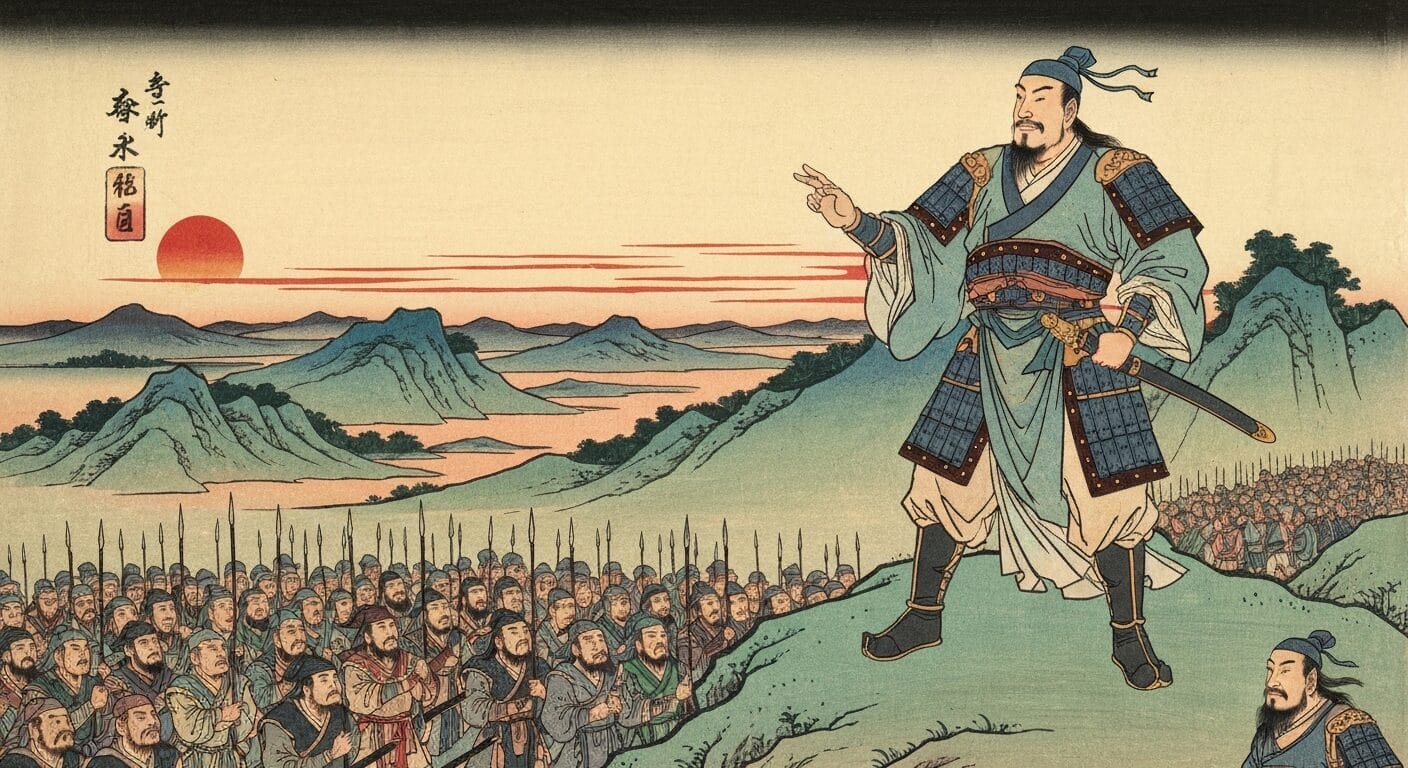
John: To understand Liu Bei, we must strip away the pageantry of the Romance of the Three Kingdoms novel and look at the historical records, primarily Chen Shou’s Sanguozhi (Records of the Three Kingdoms). Liu Bei was born in 161 AD in the declining years of the Han Dynasty. Although he claimed descent from the imperial family, by his generation, that lineage meant very little financially. He grew up fatherless and poor in Zhuo County.
Lila: So, he wasn’t born into power like his rivals Yuan Shao or Cao Cao? I read somewhere that he actually wove mats and sold straw sandals to support his mother. That feels like such a humble beginning for an emperor.
John: It was. He was a working-class man who knew the texture of common life. At fifteen, his mother sent him to study under the renowned scholar Lu Zhi. However, the historical texts offer a surprising detail here: Liu Bei was not particularly fond of reading books. Instead, he loved dogs, horses, music, and wearing fine clothes. He was essentially a charismatic youth who enjoyed social life rather than a recluse scholar. This is crucial—he built his base not on bookish theory, but on street-level interaction.
Lila: That makes him so much more relatable. He wasn’t the “perfect student.” But surely, just liking music and horses didn’t make him a leader. What was the catalyst?
John: The catalyst was the Yellow Turban Rebellion in 184 AD, a massive peasant uprising caused by famine and corruption. The government called for volunteers. Liu Bei rallied a local militia. This is where those keywords you mentioned—カリスマ営業 ・人心掌握・チームビルディング・営業向き—actually have a historical root. He didn’t have money to pay soldiers; he had to “sell” them on a vision of restoring order and protecting their homes. Wealthy merchants in the area, specifically Zhang Shiping and Su Shuang, met him, were impressed by his demeanor, and funded his militia. He didn’t have capital; he was the capital.
Character & Core Values
Lila: You mentioned his demeanor. In a world full of ruthless warlords like Cao Cao, who famously said (or is attributed to have said), “I would rather betray the world than let the world betray me,” what made Liu Bei different? What was his internal compass?
John: His core value was Ren (Benevolence or Humaneness). While Cao Cao represented the rule of law and meritocracy—often cold and efficient—Liu Bei represented the rule of virtue. Now, we must be careful not to paint him as a saint; he was a warlord who fought battles. However, historical accounts consistently highlight his kindness. There is a famous story recorded in the Sanguozhi: An assassin was sent to kill Liu Bei early in his career. However, Liu Bei treated the guest so kindly, unaware of his intent, that the assassin couldn’t bring himself to do it. He confessed and left.
Lila: That is incredible. It reminds me that how we treat strangers—even when we think no one is watching—can literally save our lives. It seems his “team building” wasn’t about strategic HR practices, but about genuine care.
John: Precisely. His leadership style was relational, not transactional. He ate at the same table as his soldiers and did not differentiate between the high-born and the low-born. This created a fanatical loyalty. When he was defeated—which happened often—his followers didn’t leave him for a winner. They followed the loser, because the loser treated them like human beings.
Turning Points & Choices
John: Let’s look at how this philosophy played out in high-stakes situations. We can identify three major turning points where Liu Bei chose humanity over expediency.
Lila: I’d love to hear these. It’s easy to be kind when things are going well, but what about when the walls are closing in?
John: The first major turning point was his time in Xinye (c. 201–208 AD). He had been defeated by Cao Cao and fled to Liu Biao in Jing Province. He spent nearly seven years there in relative stagnation. He was approaching 50 years old—an old man by the standards of that era. He famously lamented that his thighs were getting flabby from lack of riding. Yet, he chose to use this time to humble himself and seek talent, specifically Zhuge Liang.
Lila: Ah, the “Three Visits to the Thatched Cottage”? I’ve heard this is where he had to beg Zhuge Liang to join him.
John: Yes. Historically, it is true that he visited three times. Consider the ego check required here. Liu Bei was a veteran general and a regional governor; Zhuge Liang was a 27-year-old farmer-scholar with no combat experience. Liu Bei prioritized wisdom over hierarchy. He suspended his ego to ask for help.
John: The second, and perhaps most defining turning point, was the Retreat from Changban in 208 AD. Cao Cao’s massive army was pursuing Liu Bei. As Liu Bei fled, over 100,000 civilians—ordinary refugees—decided to follow him because they trusted him more than the central government.
Lila: That sounds like a logistical nightmare. 100,000 civilians would slow an army to a crawl.
John: Exactly. His advisors urged him to abandon the civilians to speed up his escape. It was the “logical” military choice. Liu Bei refused, stating, “To accomplish a great task, one must take the people as the foundation. Now that they have joined me, how can I bear to abandon them?” (Source: Sanguozhi, Biography of the Former Lord). He was eventually caught, his family was endangered, and his army was decimated. But historically, this act cemented his reputation as the only moral alternative to Cao Cao.
Lila: He lost the battle but won the war for public opinion. It shows that sometimes efficiency isn’t the highest good. If he had abandoned them, he might have saved his troops, but he would have lost his identity.
Daily Practices & Relationships
John: We often look at the big battles, but Liu Bei’s resilience was sustained by his daily habits of relationship maintenance. The records state that with his sworn brothers, Guan Yu and Zhang Fei, he would “sleep in the same bed” (a classical idiom for extreme brotherly intimacy) and treat them with the affection of kin. In public, they stood guard behind him; in private, they were equals.
Lila: That’s such a beautiful image of non-toxic masculinity. They were warriors, yet they relied on physical proximity and emotional closeness. In our modern life, we often drift away from friends because we are “too busy.” Liu Bei was trying to build a country, yet he made time to just be with his people.
John: He also practiced the art of listening. Unlike Yuan Shao, who was known for indecisiveness because he listened to too many people but trusted no one, or Cao Cao, who listened but ultimately relied on his own genius, Liu Bei listened to empower. When he entered the region of Yi Province (modern Sichuan), he immediately sought out local scholars and disgraced officials, asking for their advice. He validated people who had been ignored by the previous administration.
Lila: So, his “daily practice” was essentially validation. He made people feel seen.
John: Yes. And this brings us to a useful summary of his life strategies. Let’s look at how we can apply these historical moments to our own lives.
| Historical Episode | Situation/Conflict | Choice/Action | Outcome | Life Insight | Try This |
|---|---|---|---|---|---|
| Three Visits to the Cottage | Stagnating career; needing new expertise but facing a younger, unproven expert. | humbled himself; visited Zhuge Liang three times to request aid. | Gained a brilliant strategist who secured his future kingdom. | Humility recruits genius. Ego blocks growth. | Ask for help from someone younger or “lower” in rank than you today. |
| Refugees of Changban | Military pursuit; carrying civilians slowed escape. | Refused to abandon the vulnerable to save himself. | Heavy military losses, but eternal moral legitimacy. | Values over Efficiency. Trust is built in crisis. | When stressed, choose the kind option over the fast option. |
| Trusting Zhao Yun | Rumors spread that his general Zhao Yun had defected to the enemy. | Threw a hand-axe at the accuser, saying “Zhao Yun would never betray me.” | Zhao Yun returned with Liu’s infant son; loyalty was vindicated. | Radical Trust. Belief in others inspires them to live up to it. | Defend a friend who isn’t in the room when others gossip. |
Words & Meanings
Lila: We often hear quotes attributed to historical figures that they never actually said. Are there any verified words from Liu Bei that give us a window into his soul?
John: Yes, and the most poignant one comes from his very last days. In 223 AD, as he lay dying in Baidicheng, he wrote an edict to his son, Liu Shan. It wasn’t about tax policy or military strategy. He wrote:
“Do not do an evil thing because it is small; do not leave a good deed undone because it is small. Only through wisdom and virtue can one convince others.” (勿以惡小而為之,勿以善小而不為。惟賢惟德,能服於人。)
— Source: *Sanguozhi* (Records of the Three Kingdoms), Book of Shu, Biography of the Former Lord.
Lila: That is so simple. “Do not leave a good deed undone because it is small.” It validates the tiny gestures—holding a door, listening to a friend, being honest when it doesn’t matter. It suggests that character isn’t built in the throne room, but in the small moments.
John: Exactly. He also told his son, “Read the Han books and the Book of Rites,” emphasizing education, which he himself had neglected in his youth. It shows a regret and a wish for the next generation to be better.
Failures, Limits & Controversies
Lila: But we have to be realistic, John. He wasn’t perfect. Did his “humanistic” approach ever backfire?
John: Absolutely. In fact, his greatest failure was a direct result of his emotional attachments. In 219 AD, his sworn brother Guan Yu was captured and executed by the forces of Sun Quan (the Wu kingdom). Liu Bei was devastated. Against the advice of almost all his ministers—including Zhuge Liang and Zhao Yun—he launched a massive war against Wu for revenge.
Lila: This was the Battle of Xiaoting (also known as Yiling), right?
John: Yes. He let his personal grief override his responsibility as an emperor. He mobilized the nation for a personal vendetta. The result was a catastrophic defeat; his army was burned in their camps, and the Shu Han state never fully recovered. This is the dark side of “grasping human hearts”—sometimes, your own heart grasps you too tightly. His loyalty to his brother cost his people their security.
Lila: That’s a heavy lesson. Loyalty is a virtue, but blind loyalty can be destructive. It teaches us that we need to balance our personal affections with our wider responsibilities.
Legacy & Cultural Memory
John: Despite that failure, history—and especially literature—has been incredibly kind to Liu Bei. The novel Romance of the Three Kingdoms elevated him to a near-saintly status, contrasting him sharply with the “villain” Cao Cao. In Chinese and East Asian culture, he became the archetype of the “Virtuous Ruler.”
Lila: It’s interesting how his legacy endures not because he won the most land (he didn’t), but because he represented hope. People want to believe that a leader can be decent.
John: Correct. Even today, in shrines across Chengdu and his home province, people burn incense to him. They don’t worship his conquest; they worship his loyalty and his persistence. He proves that you can lose the battle, lose the kingdom, but if you keep your humanity, you win history.
Practical Guidance for Modern Life
John: So, to summarize the non-business lessons we can take away:
- Resilience is relational: When you hit rock bottom, your safety net is made of the people you treated well on your way up.
- Small goodness matters: Character is the sum of small choices, not just big public displays.
- Emotion needs regulation: Deep love is powerful, but without wisdom, it can lead to destructive decisions (as seen in his final war).
FAQ (For General Readers)
Q1: What are Liu Bei’s representative sayings?
The most historically verified and famous saying is from his will: “Do not do an evil thing because it is small; do not leave a good deed undone because it is small.” (Source: Sanguozhi). Another famous phrase associated with him (though likely popularized by the novel) is, “Brothers are like limbs; wives and children are like clothing,” which sounds terrible to modern ears! However, historians argue this was likely a rhetorical device used in the novel to emphasize the sanctity of the sworn brotherhood, not a literal devaluation of family, as he famously risked everything to save his son at Changban.
Q2: Which episodes best show his character?
The Retreat from Changban (refusing to abandon refugees) and the Three Visits to the Cottage (humbling himself to recruit Zhuge Liang) are the two definitive episodes. One shows his compassion for the weak; the other shows his respect for wisdom.
Q3: What parts of their story are (disputed) or legendary?
The “Peach Garden Oath” (where Liu, Guan, and Zhang swore brotherhood in a ceremony) is fictional, found in the Romance of the Three Kingdoms. However, history records that they shared a bond “like brothers” and slept in the same bed. The exact ceremony is legend, but the relationship was real. Also, the idea that he never won a battle without Zhuge Liang is false; Liu Bei was a capable commander in his own right before meeting Zhuge.
Q4: Where should a beginner start reading credible materials?
For history, start with Rafe de Crespigny’s works, such as Generals of the South or his translations of the Sanguozhi. For the literary experience, Moss Roberts’ translation of Three Kingdoms is the gold standard, but keep in mind it is a novel, not a history book.
Q5: Which sites/museums help understand their world?
The Wuhou Shrine (Temple of Marquis Wu) in Chengdu, China, is the most famous site dedicated to Liu Bei and his ministers. You can also visit his ancestral home area in Zhuozhou, Hebei Province.
Places & Sources to Explore
- Chengdu Wuhou Shrine: The only temple in China where a ruler (Liu Bei) and his minister (Zhuge Liang) are enshrined together. Official Site
- Book Source: Records of the Three Kingdoms (Sanguozhi) by Chen Shou. English excerpts are available in academic compilations on the Later Han.
- Academic Resource: Imperial Warlord: A Biography of Cao Cao 155-220 AD by Rafe de Crespigny (provides excellent context on Liu Bei as the rival).
Conclusion — What Endures
Lila: This has been such a refreshing look at Liu Bei. It turns out that those keywords—幽州涿郡涿県 ( 現在の河北省涿州市 ) and カリスマ営業 ・人心掌握・チームビルディング・営業向き—were just the tip of the iceberg. He wasn’t a salesman; he was a connector.
John: He was. In an age of fragmentation, he tried to hold things together—people, a nation, and moral standards. His life reminds us that success isn’t always about the final scoreboard. It’s about who stands beside you when the game is over. If you live with Ren (benevolence), you never truly walk alone.