📺 Learn in 1 Minute! A New Side of Toyotomi Hideyoshi (Video Guide)
Before diving into the article, check out this short video to quickly grasp the key points!

🎧 Podcast Episode
New Toyotomi Hidenaga
Listen to this article as a podcast! Two hosts break down the key points in an easy-to-follow conversation.
▶ Press play to start listening
🌐 日本語版はこちら: history-life.jp で読む
2026 Discovery: What a 16th-Century Samurai’s Letter Teaches Us About Global M&A and COO Leadership
In February 2026, a newly discovered letter issued by a vassal of the legendary samurai Toyotomi Hidenaga was unearthed in Nara, Japan. This artifact has shed unprecedented light on the organizational management skills of a man who successfully governed a domain of 1 million koku—an economic scale equivalent to a modern multi-billion-dollar multinational corporation.
In this article, we will decode this latest historical discovery and translate its 400-year-old wisdom into actionable insights for modern global business. From the intricacies of “Number 2 leadership” (the COO dynamic) to the deployment of “soft power” in cross-border Mergers and Acquisitions (M&A), Hidenaga’s strategies are strikingly relevant. As global interest peaks alongside the 2026 historical drama series Toyotomi Brothers!, let’s explore how the blueprints of 16th-century statecraft can help today’s executives navigate the complexities of the global market.
Decoding the “Soft Power” Strategy of a Multi-Billion-Dollar Enterprise
On February 16, 2026, Tenri University sent ripples through both historical and business strategy circles with a groundbreaking announcement. A previously unknown letter, sent by Yokohama Yoshinori (a senior executive/vassal under Toyotomi Hidenaga), was discovered at the Kikuoka family residence in Nara.
The letter was addressed to stakeholders at Kofuku-ji, a powerful temple with roots dating back to the 8th century. Its directive was simple but profound: it ordered the Kasuga Wakamiya On-Matsuri—a massive, province-wide traditional festival—to proceed exactly as planned under the new regime.
To the untrained eye, this looks like a standard event permit. However, in the context of organizational integration, it is a masterclass in post-merger strategy. At the time, Yamato Province (modern-day Nara) was the equivalent of a highly hostile corporate takeover target. The local temple factions possessed immense wealth, private armies (armed monks), and a long history of fierce autonomy.
Hidenaga had just been appointed as the CEO of this newly acquired territory, managing an economy of roughly 1 million koku (a GDP metric that translates to tens of billions of USD today, placing him among the top-tier corporate titans of his era). Instead of using brute force to crush the legacy stakeholders—a common mistake in modern M&A where acquiring companies aggressively dismantle local cultures—Hidenaga chose to protect and sponsor their most sacred traditions. By funding and guaranteeing their festival, he seamlessly integrated the old guard into the new Toyotomi corporate structure.
This delicate balance of hard power (military/economic dominance) and soft power (cultural respect and integration) mirrors the most successful cross-border M&A strategies today, where global conglomerates acquire regional powerhouses without destroying the local brand identity that made them valuable in the first place.
The newly discovered February 2026 letter proves that Hidenaga utilized a highly sophisticated “soft power” strategy. By protecting the traditional events of hostile local factions, he won their loyalty without expending resources on forceful subjugation.
Why Hidenaga’s Management Style is Trending in Today’s VUCA World
With the global broadcast of the 2026 historical drama Toyotomi Brothers!, Toyotomi Hidenaga is finally stepping out of the shadow of his flamboyant older brother, the supreme ruler Toyotomi Hideyoshi. Modern historical research has increasingly proven that while Hideyoshi was the visionary founder, Hidenaga was the indispensable Chief Operating Officer (COO) who actually kept the empire running.
Hidenaga officially took control of the Yamato region around 1585. Managing a vast portfolio that included Kii, Izumi, and Yamato provinces, he established his global headquarters at Koriyama Castle. He didn’t just move in; he executed a massive infrastructure upgrade, transforming a modest regional fort into a world-class corporate campus fitting for a multi-billion-dollar enterprise.
For Hideyoshi to achieve his vision of total market dominance (unifying Japan), the stability of his home base (the Kyoto-Nara economic hub) was an absolute prerequisite. Yamato was a political powder keg, filled with complex stakeholder networks, entrenched religious institutions, and local landholders. If Hideyoshi was the archetypal Silicon Valley CEO—a visionary charting aggressive expansion and disrupting markets—Hidenaga was the quintessential COO, managing complex supply chains, mitigating risks, and stabilizing operations on the ground.
A famous historical anecdote perfectly captures this dynamic. When a powerful regional CEO (daimyo Otomo Sorin) visited the Toyotomi headquarters, Hideyoshi reportedly told him: “For private matters of culture and tea, speak to Sen no Rikyu. But for all official matters of state, military, and diplomacy, speak to Hidenaga.” This was a declaration of a highly optimized corporate division of labor.
In today’s global VUCA (Volatility, Uncertainty, Complexity, and Ambiguity) environment, the era of the autocratic, top-down “hero CEO” is ending. Global markets demand “integrator” leaders who can harmonize diverse, cross-cultural teams and act as the central hub of an organization. This is exactly why Hidenaga’s 16th-century COO playbook is resonating so deeply with modern executives from Wall Street to Silicon Valley.
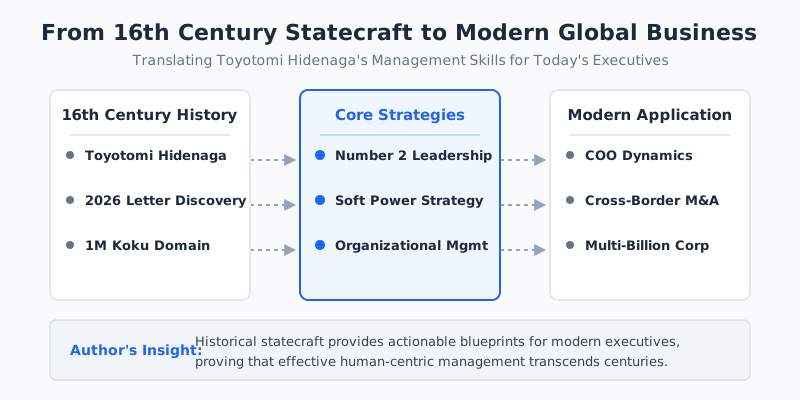
Hidenaga managed an economic zone equivalent to the largest global mega-corporations of his time. His ability to stabilize the highly volatile Yamato market makes him the ultimate historical case study for modern Chief Operating Officers.
The Perfect CEO-COO Symbiosis: Hideyoshi vs. Hidenaga
The primary reason the Toyotomi regime achieved rapid market dominance was the flawless synergy between its CEO and COO. In the 16th century, boardroom coups and hostile takeovers from within one’s own family were the norm. Regional leaders routinely assassinated their own siblings to consolidate power.
Yet, the Toyotomi brothers exhibited zero internal friction. As modern historians note, Hideyoshi viewed his brother as a highly effective, indispensable partner, while Hidenaga dedicated his life to executing his brother’s vision. Let’s analyze their leadership styles through a modern corporate lens.
| Leadership Metric | Toyotomi Hideyoshi (The CEO) | Toyotomi Hidenaga (The COO) |
|---|---|---|
| Decision-Making Style | Intuitive and top-down. Prioritized bold visions, disruptive innovation, and speed. | Logical and bottom-up. Prioritized stakeholder alignment and operational certainty. |
| Interpersonal Approach | Driven by immense charisma and overwhelming authority (Hard Power). | Driven by active listening, empathy, and cultural preservation (Soft Power). |
| Organizational Role | Aggressive new market penetration and overarching global strategy. | Post-merger integration (PMI), retention of acquired assets, and internal dispute resolution. |
| Crisis Management | High-risk, high-reward pivots to turn crises into opportunities. | Robust risk hedging, supply chain resilience, and defensive consolidation. |
Historical archives housed in the Osaka Castle Museum (specifically a 1590 official document) reveal the deep bond between the two. During a massive military campaign (the siege of Odawara), Hidenaga was too ill to manage the operations on the ground. Hideyoshi sent a letter to his bedridden brother, updating him on the chaotic siege but emphasizing, “I am simply overjoyed to hear that your health is improving.” Hideyoshi even bargained with local religious institutions, offering political favors in exchange for prayers for Hidenaga’s recovery.
Hideyoshi could keep his foot firmly on the accelerator only because Hidenaga provided world-class steering and braking systems. When Hidenaga passed away from illness in 1591, the Toyotomi corporation lost its anchor. Without its COO, the regime spiraled into disastrous overseas expansion (the invasions of Korea), internal purges, and eventual collapse. Global business analysts often point out that a visionary CEO without a grounded COO is a recipe for catastrophic overreach.
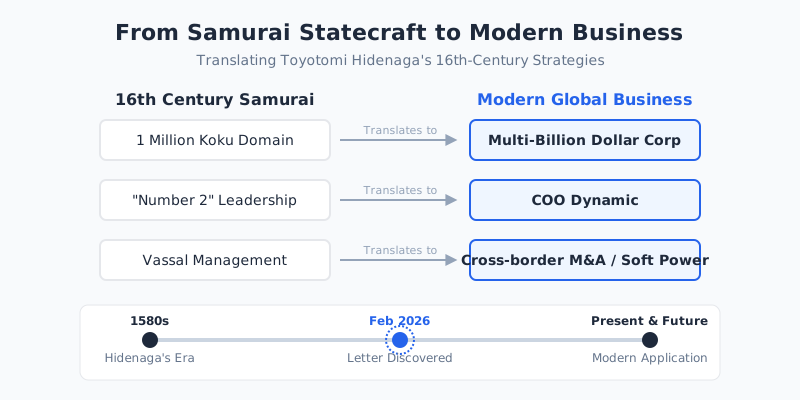
The “Hideyoshi model” drives an organization forward with an overpowering vision, while the “Hidenaga model” absorbs friction and keeps the gears turning. Modern global projects require a perfect balance of both.
The “Carrot and Stick” of Post-Merger Integration: Insights from the 2026 Letter
Let us dive deeper into the specific management tactics revealed by the February 16, 2026, document discovery.
As noted earlier, the letter was drafted by Yokohama Yoshinori, an administrative executive under Hidenaga, and directed the Kofuku-ji temple to proceed with their traditional festival. This document highlights Hidenaga’s masterful use of the “carrot and stick” approach in regional governance.
1. The Stick: Ruthless Operational Rationalization (Hard Power)
When Hidenaga upgraded his headquarters at Koriyama Castle, he demanded building materials from across the province. Because the Nara basin lacked natural stone, he ruthlessly requisitioned sacred Buddhist statues, gravestones, and foundation stones from ancient temples to build his fortress walls. Today, visitors can still see the famous Sakasa Jizo (an inverted stone deity) embedded in the castle ruins. This was a brutal, visual display of corporate compliance: “No matter how sacred your legacy systems are, you are now operating under the Toyotomi infrastructure.” It is the historical equivalent of a global acquirer forcefully migrating a subsidiary onto its centralized IT and compliance networks.
2. The Carrot: Cultural Preservation and Social License (Soft Power)
However, as the newly discovered letter proves, Hidenaga heavily subsidized and protected the region’s spiritual and cultural pillars. The Kasuga Wakamiya On-Matsuri was not just a party; it was the core identity of the local populace. Instead of banning it to suppress local unity, Hidenaga ordered it to be held “grandly, under the protection of the Toyotomi administration.”
By doing this, he forced the hostile temple factions to view him as a patron rather than an invader. Simultaneously, he won the hearts of the local workforce, who felt gratitude toward the new management for preserving their way of life. Historical records show that Hidenaga was deeply loved by the locals, and over 200,000 people attended his funeral.
Using official corporate channels to sponsor local heritage is a strategy used by today’s smartest global multinationals. When a US tech giant enters the EU or APAC markets, the most successful ones don’t just extract data; they fund local STEM programs, sponsor regional sports teams, and protect local data sovereignty to earn a “social license to operate.”
Enforce your core operational rules strictly on physical infrastructure (IT, compliance, office policies), but fiercely protect the psychological and cultural identity of the acquired team. This “carrot and stick” is the secret to M&A success.
Global Impact: Lessons for Cross-Border M&A and Modern Leadership
The discovery of this letter is far more than an archaeological curiosity; it provides a highly relevant framework for modern global executives. Specifically, for companies navigating cross-border M&As or integrating diverse international teams, Hidenaga’s governance of Yamato is the ultimate case study.
Too often, acquiring companies force their corporate culture (the hard rules) onto the acquired entity. This inevitably leads to culture clash, plummeting morale, and the mass exodus of top talent. Just as Hidenaga demonstrated absolute authority through the castle’s stone walls while simultaneously protecting the local festival, modern leaders must balance “strict corporate governance” with “respect for local identity.”
【Author’s Analytical View】
As an analyst exploring the intersection of history and modern global society, the greatest lesson from this 2026 discovery is this: True power is not forcing compliance through dominance, but “hacking” the target’s values and integrating them into your own ecosystem.
Hidenaga avoided the massive financial and human cost of going to war with the armed monks. By elevating himself to the role of “executive sponsor” of their sacred festival, he assimilated them into the Toyotomi platform without firing a single shot. This perfectly mirrors how successful global tech conglomerates operate today. When Microsoft acquired LinkedIn or GitHub, they didn’t force a hostile rebrand; they allowed them to maintain their distinct cultures and communities while quietly integrating the backend infrastructure.
Instead of crushing the pride of a subsidiary or a new team, empower it. Turn their local pride into an asset that strengthens your overarching organization. This was the genius of a man who peacefully managed a multi-billion-dollar domain, and it remains the most vital survival skill for navigating today’s complex global corporate networks.
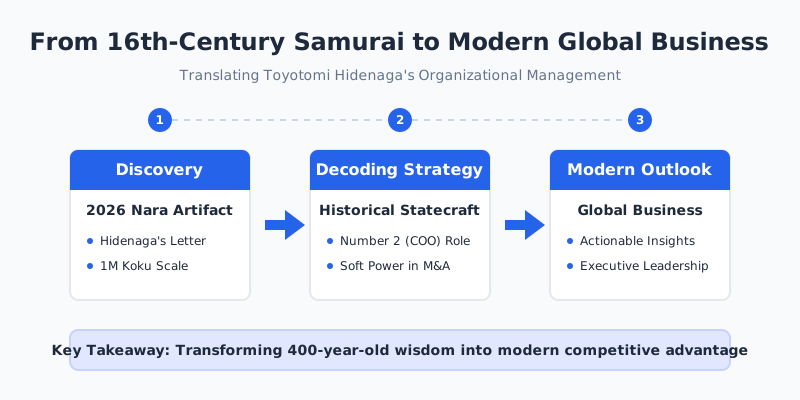
Don’t dismiss the quirks or traditions of a new team. By positioning yourself as the “patron” who supports their unique culture, you can align their goals with yours and prevent organizational friction.
3 Core Principles of Hidenaga’s Organizational Management
Based on our analysis of the historical data and modern business parallels, here are the three core pillars of Toyotomi Hidenaga’s management strategy:
1. Strict Delineation of CEO/COO Roles: Exponential growth requires two distinct engines. A visionary CEO to chart the course and disrupt the market, paired with a grounded COO to absorb friction, manage stakeholders, and execute the daily operations.
2. Mastery of Hard and Soft Power: Be uncompromising when it comes to vital infrastructure and compliance (the stone walls), but highly accommodating and protective of psychological and cultural pillars (the festivals). This balance is the key to cross-cultural integration.
3. Hacking Values for Organic Authority: Instead of fighting legacy powers head-on, sponsor the things they care about most. This “soft power strategy” naturally transitions hostile competitors into loyal stakeholders within your ecosystem.
【Editorial Note】
Through the lens of the 2026 historical drama, Hidenaga’s life as the “ultimate Number 2” is capturing the imagination of a global audience. His methods weren’t flashy, but they were built on a profound understanding of human psychology and organizational logic. We hope this latest historical discovery serves not just as a window into the past, but as a practical tool to upgrade your leadership strategies today.
The ultimate COO doesn’t force compliance through brute strength. They master the organization by respecting local cultures while quietly integrating the underlying operational systems.
Actionable Steps for Global Managers
Here is how you can apply Hidenaga’s 16th-century management playbook to your global business operations starting tomorrow:
1. Map the “CEO and COO” Dynamics in Your Team:
Identify who in your organization is the visionary (Hideyoshi) and who is the operational integrator (Hidenaga). If you are the visionary leader, your immediate priority should be finding a “Hidenaga-type” executive to delegate operational authority to, ensuring you don’t burn out or overreach.
2. Audit “Protected Cultures” During Integrations:
Whether you are managing a cross-border M&A, a departmental merger, or onboarding new international talent, pause before enforcing your standard operating procedures. Ask the incoming team: “What is the one cultural practice or workflow you want to preserve?” Protecting that one element is your first step to building trust.
3. Study History to Inform Modern Strategy:
Look beyond modern business books. Studying historical case studies—whether it’s visiting the repurposed stones of Koriyama Castle in Japan or reading academic analyses on the Toyotomi administration—provides timeless frameworks for solving modern corporate challenges.
The next time you face opposition in a project, don’t try to “defeat” the opposing argument. Instead, find a way to let the other party save face while quietly incorporating their energy into your ultimate goal.
Data Sources
The following historical data and recent news reports were referenced in the creation of this article.
- [Toyotomi Brothers!] Hidenaga’s Letter Discovered! A Glimpse into the Political Mastery of Yamato Governance – Rekishiya (Feb 17, 2026)
- Letter Proving the Skill of Toyotomi’s Younger Brother Discovered… “Valuable Historical Material Showing the Process of Enhancing Authority” – Yomiuri Shimbun Online (Feb 17, 2026)
- [To the Castle of World Domination] Koriyama Castle: The 1-Million-Koku Fortress Filled with the Wisdom of Hidenaga – Yomiuri Travel (Feb 13, 2026)
- 3 Recommended Catalogs to Understand the Hideyoshi & Hidenaga Brothers – Osaka Castle Online Shop (Jan 8, 2026)
- 《Toyotomi Brothers》 Hideyoshi’s 10+ Concubines vs. Hidenaga’s Financial Acumen… Insights by Historian Michifumi Isoda – Bunshun Online (Feb 8, 2026)
- The Protagonist of NHK’s “Toyotomi Brothers!” Was a Direct Vassal of Oda Nobunaga… Proof of the Master-Servant Relationship – PRESIDENT Online (Nov 16, 2025)
Disclaimer: The articles on this site are based on historical documents and academic research. For detailed historical accuracy, please refer to the cited academic literature.
Author Profile: Naoya — Content creator exploring the intersection of history and modern global society.