Sun Tzu’s Wisdom: How AI Rewrites Information Warfare
A 2,500-year-old military treatise predicted modern AI warfare with unsettling accuracy. Sun Tzu wrote that the supreme art of war is to subdue the enemy without fighting. Today, AI-powered information operations are doing exactly that — reshaping geopolitics, elections, and public opinion before a single shot is fired.
The Hook: Ancient Strategy Meets Exponential Technology
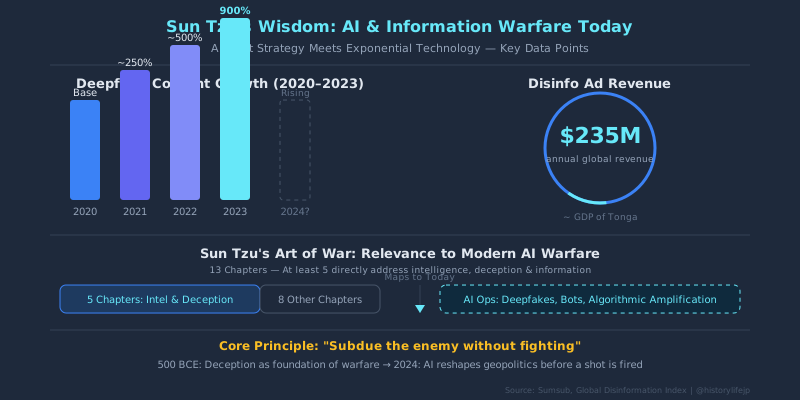
Here is a number worth sitting with. The Global Disinformation Index estimated that ad-funded disinformation generates approximately $235 million in annual revenue globally (a figure comparable to the GDP of a small Pacific island nation like Tonga). Meanwhile, deepfake (AI-generated fake video or audio designed to look real) content online grew roughly 900% between 2020 and 2023, according to security researchers at Sumsub. Sun Tzu never imagined algorithmic amplification, but his core thesis — that deception is the foundation of warfare — maps onto the present with uncomfortable precision.
The Art of War, likely composed around the 5th century BCE during China’s Warring States period, contains thirteen chapters. At least five deal directly with intelligence, deception, and the manipulation of an adversary’s perception. These are not fringe chapters. They sit at the heart of Sun Tzu’s strategic framework. And they describe, in principle, what nation-states and non-state actors are now executing at machine speed.
Deepfake content surged roughly 900% in three years. Sun Tzu’s 2,500-year-old treatise devoted nearly 40% of its chapters to deception and intelligence — themes now supercharged by AI tools accessible to almost anyone.
Background: Why Sun Tzu Matters More Now Than in Any Modern War
If you use ChatGPT daily, you already understand the core enabling technology. LLMs (Large Language Models — the AI architecture behind tools like ChatGPT, Claude, and Gemini) can generate persuasive text at scale. Image generators can fabricate photorealistic scenes in seconds. Voice cloning tools can replicate a person’s speech from a few seconds of sample audio. Each of these capabilities maps directly onto a principle Sun Tzu articulated millennia ago.
Why does this matter now, specifically? Three converging forces:
1. Cost collapse. Producing convincing disinformation used to require state-level resources — propaganda ministries, broadcasting infrastructure, trained operatives. Today, a single individual with a laptop and a $20/month AI subscription can generate thousands of unique, targeted messages per day.
2. Speed of deployment. Sun Tzu emphasized that speed is the essence of war. AI-generated content can be created and distributed in minutes, far outpacing the news cycle’s ability to fact-check or respond. By the time a correction is issued, the false narrative has already shaped perception.
3. Targeting precision. Ancient generals relied on spies to understand enemy psychology. Modern information operations use social media analytics, behavioral profiling, and micro-targeting (delivering customized messages to narrow audience segments based on their data profiles) to deliver the right deception to the right person at the right time.
This is not hypothetical. During the early months of the Russia-Ukraine conflict beginning in 2022, both sides deployed information warfare at unprecedented scale. Deepfake videos surfaced showing Ukraine’s President Zelenskyy apparently telling his troops to surrender. The video was quickly debunked, but it demonstrated the operational concept. Sun Tzu’s principle — “All warfare is based on deception” — had been automated.
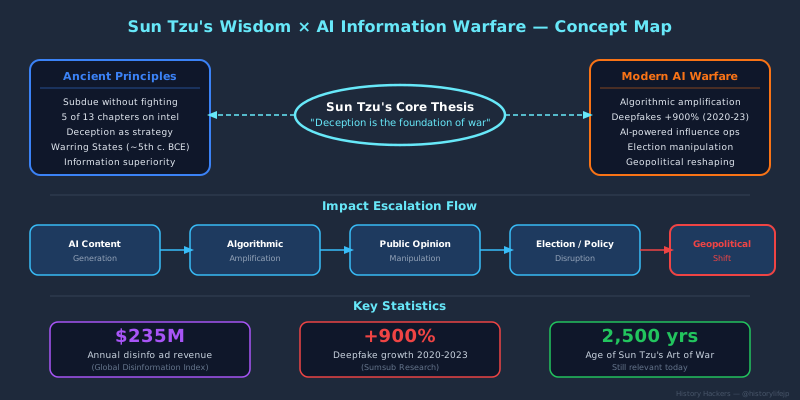
The three forces making Sun Tzu newly relevant — cost collapse, speed, and targeting precision — are the same forces that make your daily AI tools so useful. The technology that helps you draft emails also enables information warfare at industrial scale.
Analysis: Mapping Sun Tzu’s Principles to Modern AI Operations
Let us be specific. Sun Tzu’s strategic framework is not a vague metaphor for modern conflict. Individual principles from the Art of War correspond to documented AI-enabled operations with striking directness.
| Sun Tzu’s Principle | Original Context (5th c. BCE) | Modern AI Application | Documented Example |
|---|---|---|---|
| “All warfare is based on deception” | Use feints, false flags, and misdirection to confuse the enemy | Deepfakes, AI-generated news articles, synthetic social media personas | Zelenskyy deepfake surrender video (2022) |
| “Know the enemy and know yourself” | Intelligence gathering through spies and scouts | Social media data mining, behavioral profiling, sentiment analysis | Cambridge Analytica’s voter profiling (2016, est. 87 million Facebook profiles affected) |
| “Supreme excellence consists in breaking the enemy’s resistance without fighting” | Undermine morale, create internal division, avoid direct battle | Coordinated inauthentic behavior on social platforms to polarize societies | Internet Research Agency operations targeting U.S. elections (documented in Mueller Report, 2019) |
| “Use spies for every kind of business” | Five types of spies: local, inside, reverse, dead, living | AI-powered OSINT (Open Source Intelligence — gathering information from publicly available sources), automated surveillance, bot networks as “digital spies” | Bellingcat’s OSINT investigations using publicly available satellite and social media data |
| “Attack where he is unprepared, appear where you are not expected” | Strike at psychological and logistical weak points | Zero-day information attacks timed to election cycles, crisis moments, or breaking news | Coordinated disinformation campaigns during COVID-19 pandemic (WHO “infodemic” declaration, 2020) |
| “The skillful leader subdues the enemy’s troops without any fighting” | Win through diplomacy, economics, or psychological pressure | AI-generated influence campaigns targeting military morale and civilian support | Multiple nations’ documented efforts to use social media bots to demoralize opposing forces |
The Fifth Column Has Gone Digital
Sun Tzu’s chapter on espionage describes five types of spies. The most dangerous, in his framework, is the “reverse spy” — an enemy agent turned to your side. The modern equivalent is arguably the compromised algorithm. When a social media platform’s recommendation engine (the automated system that decides what content you see next) amplifies divisive content because it drives engagement, it functions as an unwitting agent of discord. No human spy required.
This is a critical insight for anyone who uses social media daily. The content you see is not neutral. It has been filtered, ranked, and amplified by systems that optimize for engagement — and emotionally provocative content, including disinformation, tends to generate more engagement. A 2021 study by researchers at MIT found that false news stories on Twitter spread roughly six times faster than true ones. Sun Tzu would have recognized this dynamic instantly: the terrain itself has become weaponized.
Are you consuming information or being consumed by it? Sun Tzu’s framework suggests asking: who benefits from my emotional reaction to this content? If the answer isn’t clear, you may be on the receiving end of an information operation — even a small, commercially motivated one.
Case Studies: Where Ancient Strategy Met Modern Machines
Case 1: The Ghost Army, Then and Now
In World War II, the U.S. Army’s 23rd Headquarters Special Troops — the “Ghost Army” — used inflatable tanks, sound effects, and fake radio transmissions to deceive German forces about the size and location of Allied units. Approximately 1,100 soldiers created the illusion of a 30,000-strong force. The deception contributed to the success of several operations, including the Normandy invasion preparations.
Today’s digital equivalent operates at incomparably greater scale. Automated bot networks (software programs that mimic human social media accounts) can create the illusion of mass public opinion shifts overnight. A single operator can manage thousands of synthetic personas. The principle is identical to the Ghost Army — create a false picture of reality — but the cost per “soldier” has dropped from the salary of a trained operative to fractions of a cent per bot interaction.
Case 2: The Tallinn Cyberattacks and Hybrid Warfare
In 2007, Estonia experienced coordinated cyberattacks that disrupted government, banking, and media websites. This is widely considered one of the first instances of state-level cyber warfare against a nation’s infrastructure. While not AI-driven by today’s standards, the attacks demonstrated the principle Sun Tzu expressed as “the highest form of generalship is to baulk the enemy’s plans.” Disrupt the enemy’s systems, and you don’t need to fight their army.
Fast forward to today. AI now enables autonomous cyber operations that can identify vulnerabilities, craft targeted phishing messages, and adapt in real-time. The Estonian experience was a proof of concept. AI has turned it into a scalable playbook.
Case 3: Taiwan Strait Tensions and the Information Dimension
Cross-strait relations between China and Taiwan represent possibly the most active information warfare theater today. Reports from Taiwan’s government indicate that the island faces thousands of disinformation attempts monthly, many appearing to use automated content generation. Taiwan has responded by investing in media literacy programs and rapid-response fact-checking networks — a modern application of Sun Tzu’s defensive counsel: “Invincibility lies in the defense.”
These aren’t abstract scenarios. If you’ve ever seen a suspicious “news” article shared widely on social media, only to discover it was fabricated, you’ve witnessed the same deception principle the Ghost Army used — just digitized and scaled by orders of magnitude.
How This Affects Your Work and Life
You might think information warfare is something that happens between governments. It isn’t. The same tools and techniques trickle down into everyday domains that directly affect you.
In Your Career
Corporate disinformation is real. Companies face AI-generated fake reviews, synthetic competitor attacks, and deepfake impersonation of executives. In early 2024, a finance worker in Hong Kong was reportedly tricked into transferring $25 million after a video call in which every other participant was a deepfake — including the company’s CFO. Sun Tzu’s warning about deception is now an HR and cybersecurity issue.
AI literacy is becoming a job requirement. Understanding how AI-generated content works — its tells, its limitations, its patterns — is no longer optional for knowledge workers. It is a professional survival skill, much as literacy itself was in centuries past.
In Your Daily Information Diet
Your news feed is a battlefield. Not melodramatically — structurally. Algorithms select what you see based on engagement predictions. Bad actors exploit these algorithms. Your attention is the territory being contested. Sun Tzu wrote extensively about terrain; your digital information environment is the terrain of modern conflict.
Verification takes seconds but saves hours. Reverse image search, checking source URLs, reading beyond headlines, cross-referencing claims with established wire services — these are the modern equivalents of Sun Tzu’s intelligence gathering. They cost almost nothing and protect against almost everything.
In Your Understanding of Democracy
Free societies depend on informed citizens making decisions based on roughly accurate information. When AI can generate unlimited quantities of plausible-seeming false information, and when platforms amplify that content for engagement, the foundation of democratic decision-making is under stress. This is not a partisan observation. It affects every political orientation equally.
The $25 million deepfake fraud case demonstrates that information warfare isn’t just geopolitics — it’s business risk. If you manage teams, budgets, or communications, understanding AI-enabled deception is now part of your job description.
Defenses: What Sun Tzu Would Recommend Today
Sun Tzu was not only an offensive strategist. His framework includes extensive defensive doctrine. Applied to the current information environment, several defensive principles emerge.
“Know yourself” — Understand your own cognitive biases (systematic patterns of thinking that deviate from rational judgment). You are more likely to believe and share information that confirms what you already think. This is the vulnerability that information operations exploit most effectively.
“Hold ground that cannot be taken” — Build information habits that are resilient to manipulation. Follow multiple credible sources. Be skeptical of content that provokes strong emotional reactions immediately. If something makes you furious within three seconds of reading it, that is a signal to slow down, not speed up.
“The general who wins the battle makes many calculations before the battle is fought” — Preparation matters more than reaction. Media literacy, digital hygiene, and critical thinking are preparations. They are most effective when practiced before encountering disinformation, not after.
| Defense Layer | Sun Tzu’s Principle | Practical Action for You | Time Required |
|---|---|---|---|
| Personal awareness | “Know yourself” | Identify your 3 biggest confirmation biases | 30 minutes of honest reflection |
| Source diversification | “Do not repeat the tactics which gained you one victory” | Follow at least 3 news sources from different perspectives | 15 minutes to set up |
| Verification habit | “Use spies for every kind of business” | Reverse image search and cross-reference before sharing | 30 seconds per claim |
| Emotional circuit breaker | “No ruler should put troops into the field merely to gratify his own spleen” | Wait 10 minutes before sharing anything that makes you angry | 10 minutes of patience |
| Technical literacy | “Know the enemy” | Learn basic deepfake detection cues (odd eye reflections, lip sync issues) | 1 hour of initial study |
Sun Tzu’s best defense is preparation, not reaction. The “emotional circuit breaker” — waiting 10 minutes before sharing rage-inducing content — is probably the single highest-impact habit you can build. It costs nothing and neutralizes the most common attack vector.
Summary: Three Core Insights
1. Sun Tzu’s framework is not a metaphor — it is a blueprint. The Art of War‘s emphasis on deception, intelligence, and winning without fighting maps onto AI-enabled information warfare with structural precision, not just poetic similarity.
2. The cost of information warfare has collapsed. What once required state-level resources now requires a laptop and an AI subscription. This democratization of deception means that individuals, companies, and small groups — not just nations — can be both perpetrators and targets.
3. Defense is individual, not institutional. Governments and platforms will likely always lag behind attackers. Your best protection is personal: media literacy, source diversification, emotional discipline, and basic verification habits.
Author’s Take
As someone who builds AI tools daily and studies how these systems actually work under the hood, I find the Sun Tzu parallel both illuminating and sobering. The parallel is not surface-level. When I read Chapter 13 of the Art of War — on the use of spies — and then look at how modern OSINT tools scrape, correlate, and analyze publicly available data, the structural logic is identical. Only the speed and scale have changed.
What concerns me most is not the sophisticated nation-state operations. Those have always existed in some form. What concerns me is the casual availability of these capabilities. I can generate a convincing fake news article in under a minute using commercially available tools. I can clone a voice from a 15-second sample. I can create a synthetic social media persona that would fool most casual observers. I don’t do these things, but the point is that the barrier is gone. Sun Tzu assumed that deception required skilled generals and trained spies. The modern equivalent requires a credit card and an afternoon.
The most useful lesson from Sun Tzu, in my view, is not about offense at all. It is his insistence that victory begins with self-knowledge. In the information warfare context, this means understanding your own vulnerabilities — your biases, your emotional triggers, your tendency to share before verifying. That internal work is not glamorous, but it is the most effective defense available. No algorithm can protect you as well as your own disciplined skepticism. History does not repeat exactly, but it often provides the structural grammar for understanding the present. Sun Tzu wrote that grammar 2,500 years ago. We are still conjugating his verbs.
Sun Tzu’s 2,500-year-old playbook maps onto modern AI information warfare with structural, not just metaphorical, precision. Your best defense is not a better algorithm — it is disciplined, skeptical thinking applied consistently to your daily information diet.
Next Steps: What You Can Do Today
1. Install an emotional circuit breaker. For one week, commit to waiting 10 minutes before sharing any content that triggers a strong emotional reaction. Track how often the impulse fades. This single habit defeats the most common vector of information warfare — emotional manipulation.
2. Diversify your information sources. Open a new browser tab right now. Subscribe to or bookmark one credible news source you don’t currently follow — ideally from a different country or editorial perspective than your usual reading. The BBC, Reuters, AP, and similar wire services prioritize factual reporting over engagement optimization. Having multiple perspectives is what Sun Tzu meant by comprehensive intelligence.
3. Learn one deepfake detection technique. Spend 30 minutes studying the common tells of AI-generated content: inconsistent lighting, unusual eye reflections, artifacts around hairlines and ears in video, and overly smooth skin textures. The MIT Media Lab and organizations like the Witness Media Lab offer free resources on this. You don’t need to become an expert — you need to become slightly harder to fool than average.
Data Sources
- Sun Tzu, The Art of War — translated by Lionel Giles (1910), available via Project Gutenberg
- Sumsub Identity Fraud Report 2023 — deepfake growth statistics: sumsub.com/fraud-report-2023
- MIT study on spread of false news (Vosoughi, Roy, Aral, 2018), published in Science: science.sciencemag.org
- Mueller Report (2019) — documentation of Internet Research Agency operations: justice.gov
- World Health Organization — “Infodemic” declaration and resources: who.int/health-topics/infodemic
- NATO Strategic Communications Centre of Excellence — reports on information warfare: stratcomcoe.org
- Global Disinformation Index — research on disinformation economics: disinformationindex.org
- Bellingcat — open-source investigation methodology: bellingcat.com
Disclaimer: The articles on this site are based on historical sources and academic research, but interpretations may include the author’s personal analysis. Please refer to academic literature for further details.
About the Author: Naoya
Naoya is a content creator who explores the intersection of history and modern society. He distills wisdom and lessons from past events into accessible insights that resonate with today’s world.
🔗 Follow on X: @historylifejp